
How Cognitive Behavioural Therapy Treats Binge Eating and What to Expect From Sessions
If you are struggling with binge eating, you may have been told that Cognitive Behavioural Therapy (CBT) can help. But knowing that CBT is a recommended treatment doesn’t necessarily tell you very much about what will actually happen in therapy.
Will you be told what to eat? Will you have to keep a food diary? Will therapy focus on your weight? And perhaps most importantly, can it actually help you stop binge eating?
Cognitive behavioural therapy for binge eating is a practical, structured treatment that helps you and your therapist understand what is driving and maintaining your binge eating, and gradually start to change those patterns.
It isn’t simply about being given advice on what or how much to eat. Good CBT looks at the whole picture – your eating patterns, thoughts and beliefs about food, emotions, body image and the situations in which binge eating tends to happen.
You also don’t necessarily need a diagnosis of binge eating disorder to seek help. People can experience recurrent or distressing binge eating without meeting all the criteria for a particular eating disorder, and treatment should be based on what you are struggling with rather than simply on a diagnostic label.
Does CBT work for binge eating?
CBT has a strong evidence base for binge eating disorder and other eating disorders where binge eating is a significant feature, and is one of the psychological treatments recommended within UK treatment guidelines.
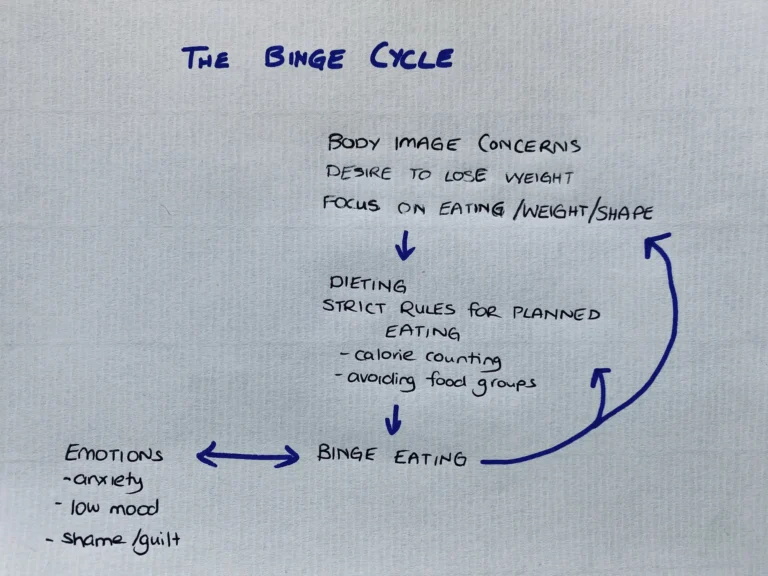
One thing that can sometimes be surprising is that CBT for binge eating is not a weight-loss treatment. In fact, repeated attempts to diet, restrict food or “make up” for a binge can often become part of the cycle that keeps binge eating going.
So, particularly in the early stages of treatment, the focus is usually on helping eating become more regular and predictable, reducing binge episodes and beginning to understand what tends to trigger them.
What actually happens in CBT sessions for binge eating?
The starting point is understanding your binge eating rather than assuming that everybody binges for the same reasons.
Your therapist will probably want to know what tends to happen before a binge, what happens during it and how you feel afterwards. They will also be interested in what your eating looks like during the rest of the day. Do you skip meals? Are there foods you don’t allow yourself to eat? Do you try to compensate after a binge? Are there particular emotions or situations that make binge eating much more likely?
Over the first few sessions, you and your therapist start to build a picture of the cycle that is keeping the problem going. Treatment then gives you practical ways of beginning to interrupt it.
Keeping track of eating and binges
Early in CBT you will usually be asked to monitor your eating, including any binge episodes and what was happening around them.
This isn’t about calorie counting or judging whether you have eaten “well” or “badly”. It is a way of gathering information. You might discover, for example, that binges happen much more often on days when you have skipped lunch, after a particularly stressful day, or once you have eaten something you had previously labelled as “forbidden”.
Those patterns give you and your therapist somewhere useful to start.
Getting eating more regular
This is a really important part of treatment and can initially feel quite strange.
If you have binged, your natural reaction the following day may be to eat less, skip breakfast or try to be “good”. Unfortunately, that can leave you hungry and preoccupied with food later in the day, making another binge more likely.
CBT therefore usually involves working towards regular meals and snacks and gradually reducing restrictive food rules. The aim is to make eating more predictable and break the binge-restrict cycle.
If this part of treatment is particularly difficult, it can be helpful to work with a specialist eating disorder dietitian alongside your therapist.
Understanding the thoughts and feelings behind binge eating
Once eating is becoming more regular, therapy will usually look more closely at the thoughts, emotions and situations connected with binge eating.
You might notice very rigid rules about food, or all-or-nothing thoughts such as, “I’ve already ruined today, so I might as well carry on.” For somebody else, binge eating might have become a way of switching off from anxiety, loneliness, boredom or overwhelming emotions.
There isn’t one explanation that applies to everybody.
The aim of CBT is to understand the role binge eating has come to play for you and develop other ways of responding, while also challenging some of the beliefs and behaviours that keep the cycle going.
How quickly should CBT help?
People often want to know how long it will take before they notice a difference. There isn’t one answer to this. CBT is generally a time-limited treatment delivered over a planned course of sessions, but the length of treatment will depend on your individual presentation and what else may need addressing alongside the binge eating.
Some people notice changes fairly early, particularly once they begin eating more regularly and can recognise situations in which they are vulnerable to bingeing. Other parts of recovery – such as changing longstanding beliefs about food, weight, shape or self-worth – may take considerably longer.
Progress is rarely linear. Having a binge during treatment does not mean that CBT isn’t working. In fact, looking carefully at what happened can give you and your therapist really useful information about what still needs to change and which skills might help next time.

What if I am neurodivergent?
CBT, as with all psychological therapies, shouldn’t be delivered identically to everybody.
For autistic people and people with ADHD, it may be important to think about things such as sensory sensitivities, executive functioning, interoception, impulsivity, routines and communication preferences.
Sometimes relatively small adaptations make a big difference. A therapist might make sessions more structured, adapt monitoring tools, use more concrete or visual information, allow additional processing time, or think differently about planning and routines around food.
Sensory needs around food may also be genuinely important and shouldn’t simply be treated as an eating disorder behaviour that needs to be challenged.
This is one of the reasons we think specialist experience matters. If a standard CBT strategy isn’t working, the answer isn’t necessarily to keep pushing harder with the same strategy. Sometimes the treatment itself needs adapting.
Do I need anything alongside CBT?
Not necessarily. Some people can work very effectively with one therapist. For others, binge eating sits within a more complicated picture.
You might also be struggling with ADHD, autism, depression, anxiety or trauma. Your eating may be very chaotic, or you may need more specialist nutritional support.
In these situations we might recommend bringing other members of the team into treatment. For example, a psychologist might provide CBT while an eating disorder dietitian works with you on nutrition and eating patterns. A psychiatrist might become involved where medication, ADHD or another mental health difficulty needs assessment or treatment.
With your consent, the team can work together rather than you having to manage several separate strands of treatment yourself.
If weekly outpatient sessions aren’t quite enough, we can also provide more intensive support through our Intensive Outpatient Programme (IOP). This allows us to increase the amount of psychological, dietetic and practical eating support while somebody continues living at home.
Accessing CBT for binge eating privately
CBT for binge eating may be available through NHS eating disorder services, although what is available, eligibility criteria and how long you wait will depend on where you live.
Private treatment is another option. It may offer quicker access to treatment and can be helpful if you need appointments to fit around work, university or family life, would prefer online treatment, or want to choose a clinician with particular expertise.
At The London Centre, we offer specialist eating disorder assessment and treatment both face-to-face and remotely. We don’t assume that everybody with binge eating needs the same package of care. An assessment is an opportunity to understand what is happening and work out whether CBT on its own is likely to be enough, or whether dietetic, psychiatric or more intensive support would be helpful alongside it.
Frequently asked questions
What does cognitive behavioural therapy for binge eating actually involve, and does it work?
CBT involves understanding the individual cycle behind your binge eating and then working systematically to change it. Treatment usually includes monitoring eating and triggers, establishing regular eating, reducing restriction or compensatory behaviours and working on the thoughts and beliefs that make binge eating more likely. It is one of the best-established psychological treatments for binge eating disorder.
How does CBT compare with nutritional counselling for treating binge eating?
They do different things. CBT focuses primarily on the psychological and behavioural processes that maintain binge eating, while an eating disorder dietitian can provide more specialist support around nutrition and eating patterns. Some people need one or the other; for others, having both working together is particularly helpful.
What should you look for in a specialist clinic for binge eating?
We would suggest looking for clinicians who have specific experience of treating eating disorders, rather than simply general CBT experience. It is also worth asking whether treatment can be adapted to your needs and whether the service offers things that may matter to you, such as online appointments, flexible appointment times and access to dietetic or psychiatric support if needed.
How is CBT adapted for neurodivergent clients, and how does it combine with dietetic or psychiatric input?
There is no single “neurodivergent version” of CBT. Adaptations should be based on the individual and might include more structure, concrete or visual strategies, sensory considerations, different approaches to self-monitoring, or additional support with planning and executive functioning. Where needed, this can sit alongside specialist dietetic or psychiatric input as part of one coordinated treatment plan.
How does private CBT for binge eating compare with NHS waiting-list options?
NHS services can provide evidence-based eating disorder treatment without the cost of private care and will be the right option for many people. However, availability, referral criteria and waiting times vary between areas. Private treatment may offer quicker access and greater flexibility, or the option to work with a particular specialist or multidisciplinary team. Which route is most appropriate will depend on your needs and circumstances.